
The Jockey Box Project
What is a jockey Box? Well, simply it is a way to take a warm keg of beer and dispense it cold. There are many versions, sizes, and materials to use to create your own Jockey Box. For the purposes of this post I’ll focus on what I’ve done to build mine. I brew a lot of beer and keg most of it, so at any give time I could have 3-8 kegs of beer on hand. For the most part, I keep 3 kegs in my Kegorator, but that is in my basement and when we have parties I don’t want people going down to my Man Cave to get a beer. The solution to my problem was a semi portable kegorator other wise known as a jockey box. A jockey box basically consists of a cooler, a number of taps, coiled line for the beer, co2 tank, ice, and keg(s) of beer.
The First step is to order all the parts you need.
- cooler, make sure it is big enough to put the number of taps on the front you want
- taps
- food grade PVC flex plastic tubing(3/16″), 25′ per tap
- 1/2″ PVC tubing, 42″ per tap
- 4-1/2″ 90deg PVC tube per tap
- 1 4way 1/2″ PVC junction per tap
- PVC glue & primer
- waterproof epoxy
- colored zip ties, 1 color for each tap
- ball lock liquid fitting 1/4″ with barb (for each keg)
- 3′ of 5/16″ I.D. gas line (for each keg)
- 5/16″ barbed swivel nut(for each keg)
- gray threaded ball lock gas disconnect
- Gas manifold (if more then 1 keg), should match number of tabs
- Dual Gauge Gas Regulator
- 5lb co2 tank
What I did to make sure I had all the right parts was to order a 4 draft system from Midwest Homebrewing Supplies. This included, Corney Kegs, Gas Regular, 4-way gas manifold, Picnic taps, and all the gas lines and connectors/clamps. I also ordered from Midwest 4 Refrigerator Tap Conversion Kits, which are basically Chrome taps with long shanks to fit though the wall of the cooler. The last thing to buy (I already had the 1/2″ PVC plumbing tubing) was 100′ of 3/16″ flex plastic tubing, which I got from MicroMatic.com. At home Depot, Lowes, or local Hardware store you can get the PVC plumbing & cement and the quick ties.
1 – prepare the holders for the 25′ of tubing.
Please, read through before cutting or gluing. Repeat these steps for each holder. Cut 4 – 8″, 4 – 1.5″ sections of plumbing tubing (not the flex). Before you cut: measure the inside width of you cooler to make
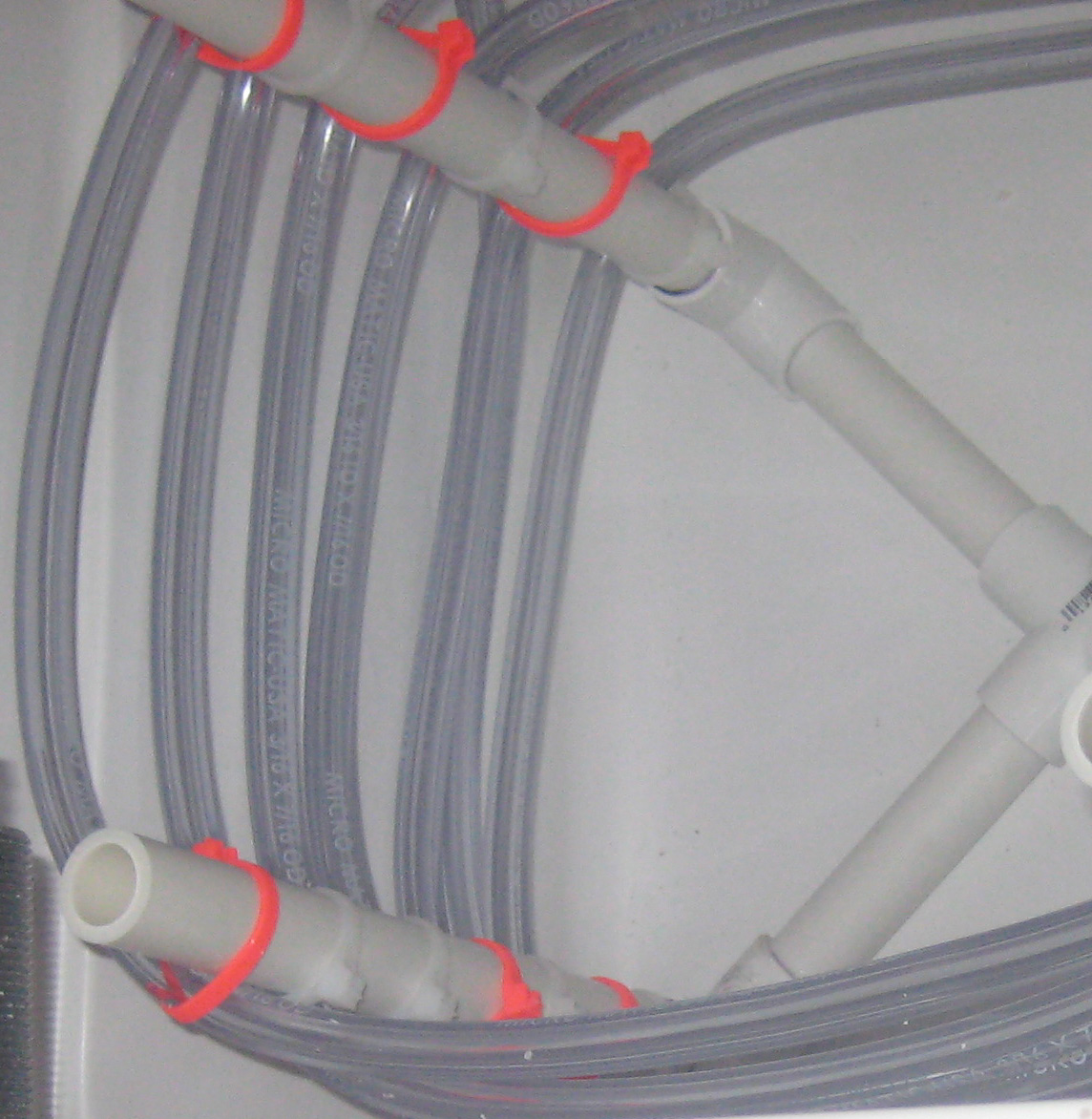
sure the width of the cooler is at least 7″ * number of Taps wide. If you don’t have enough width, reduce the width of the 1.5″ sections or the number of taps. The 8″ pieces are the vertical supports, glue each vertical piece into 1 90deg elbow. With each 1.5″ piece glue it into the 4-way junction. Warning: PVC primer and glue are very toxic, use in a well ventilated area and it dries within seconds. Finally glue each elbow into the 1.5″ piece from the 4 way junction. Make sure each vertical support is perpendicular to the 4-way junction.
2 – Attach the flexible tubing to the holders
Using a 25′ length of flexible PVC tubing, starting at the bottom of the PVC holder begin wrapping the tubing around the structure, be sure to leave about a 3′ tail at the beginning/bottom (this will be the end that attaches to the keg). With each turn that gets wrapped around the holder, attach the tubing with the same color zip tie. If you have more then one tap, color coordinating them is an easy way to see what time goes where. As you approach the end, leave at least a 1′ section of tubing that will attach to the tap.
3 – Attach the taps to the cooler
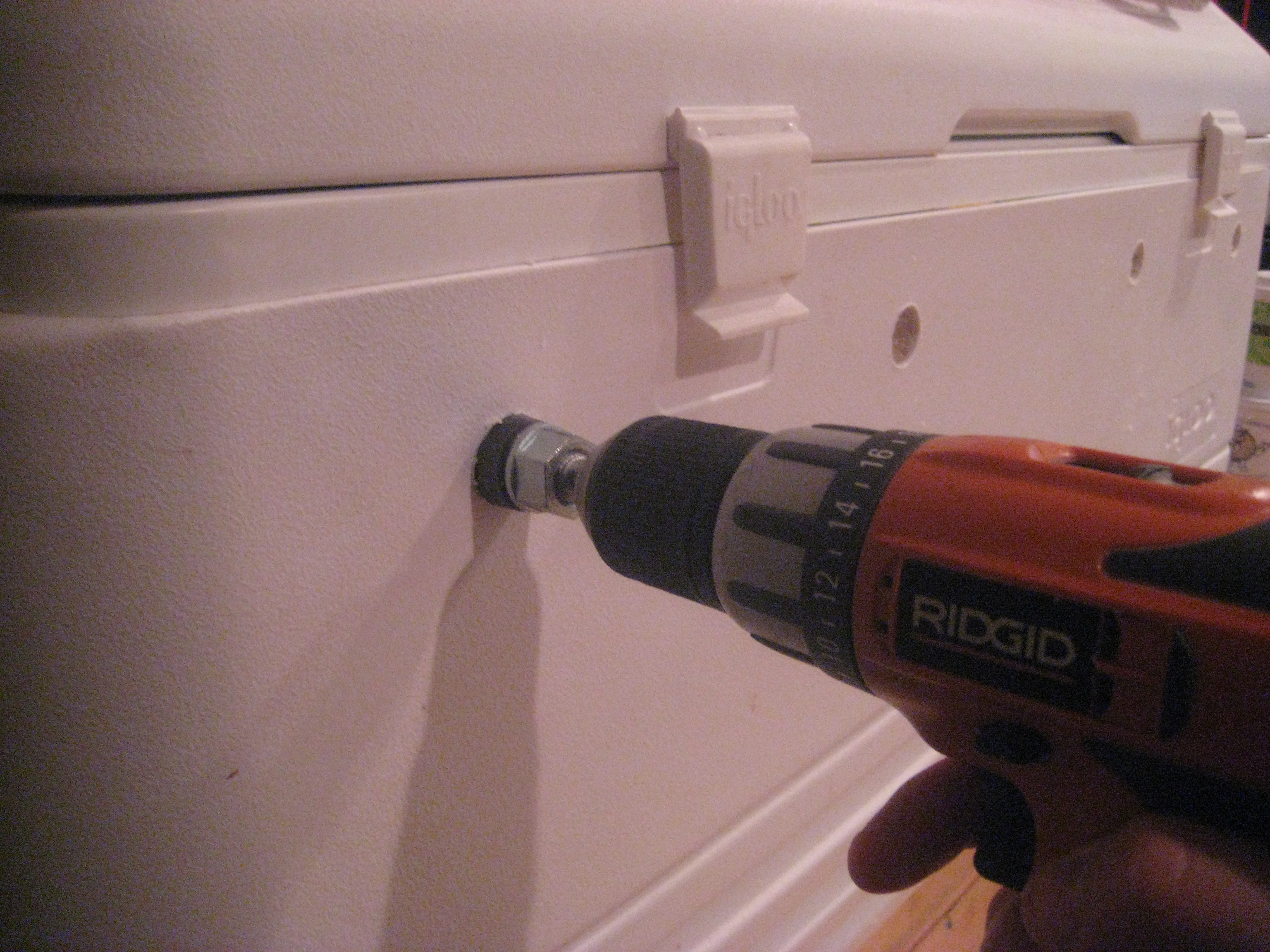
With a hole saw, cut a hole that matches the shank of you tap; in my case it was a 1″ hole. Be careful as you cut because you are going to be cutting through both plastic and insulation. Once you get you hole drilled, insert the shank for the tap in the hole and with the nut for the shank, tighten until the tap is firmly in place. Be aware, your tightening against plastic, if you go too far then you could break or damage the cooler.
4 – Make the holes for the beer line
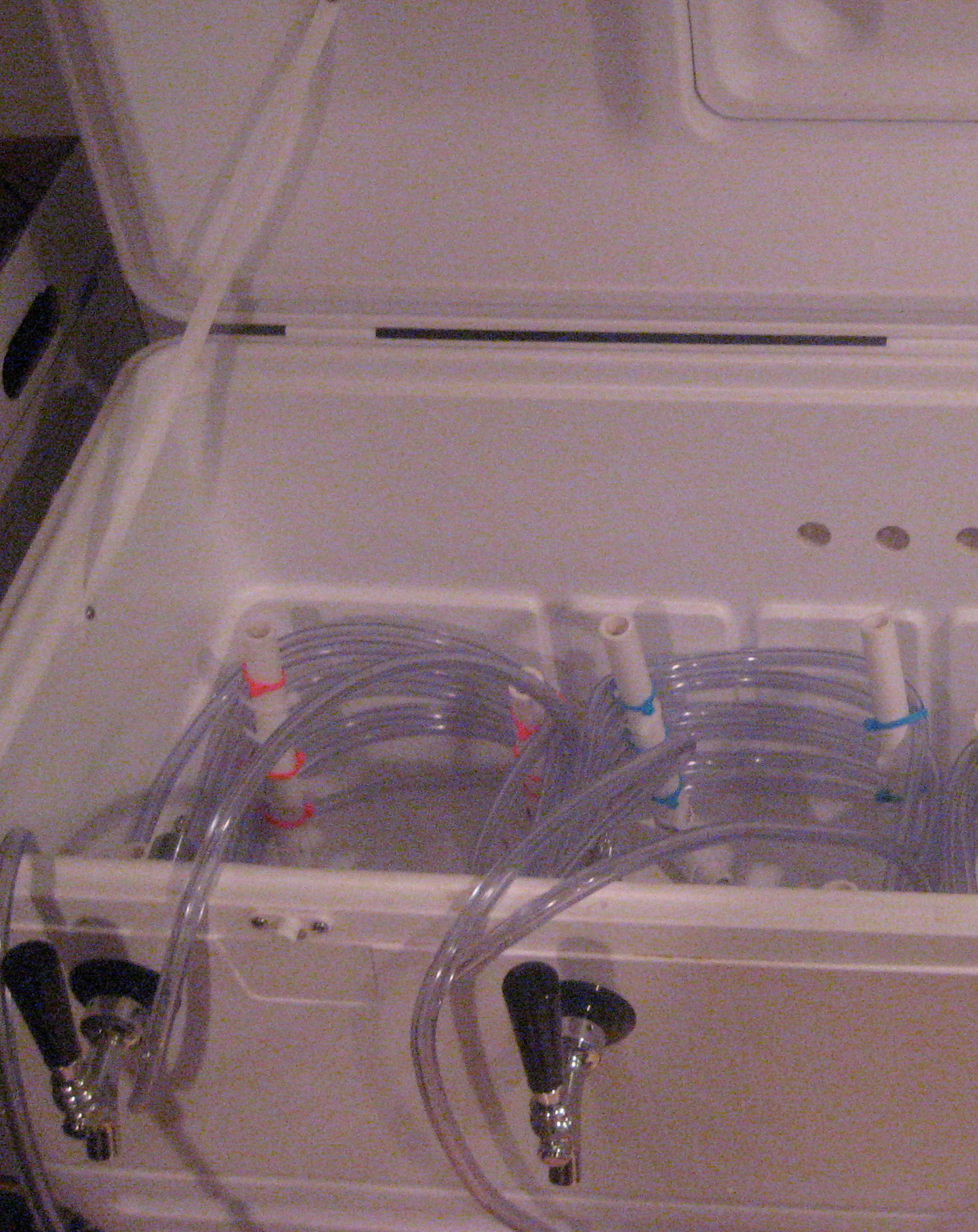
Drill the same number of holes as you have taps in the back of the cooler that match the diameter of PVC plumbing tubing, I used a 5/8″ Forster bit for the 1/2 PVC tubing. One I got these wholes drilled, I cut lengths of PVC tubing to match the length of the hole and then epoxied the PVC tubes to the cooler. I could have used grommets with smaller holes, but that would mean leaving the tail ends of the tubing out side of the cooler when it isn’t in use. With these nice holes I can pull the tubing in and out without damaging it.
5 – attach the beer line
First attach the 1′ head of all the tubing to the tap. Boil water and let the last inch or so of the beer line sit in the hot water for a couple minutes. This will make the PVC softer so it will fit on to the barb easily. There should be a 1/4 barb at the back of the shank that is attached to the tap; attach the beer line to that barb.
Soak the end of the 3′ tail in the hot water. In the Kit I bought there were picnic taps, cut the PVC tubing from the ball lock beverage quick attachment (usually black) on the party tap. Attach the beverage quick attachment to the tail end of the 25′ beer line. This piece will attache to the out post of your keg.
6 – Attach the gas manifold
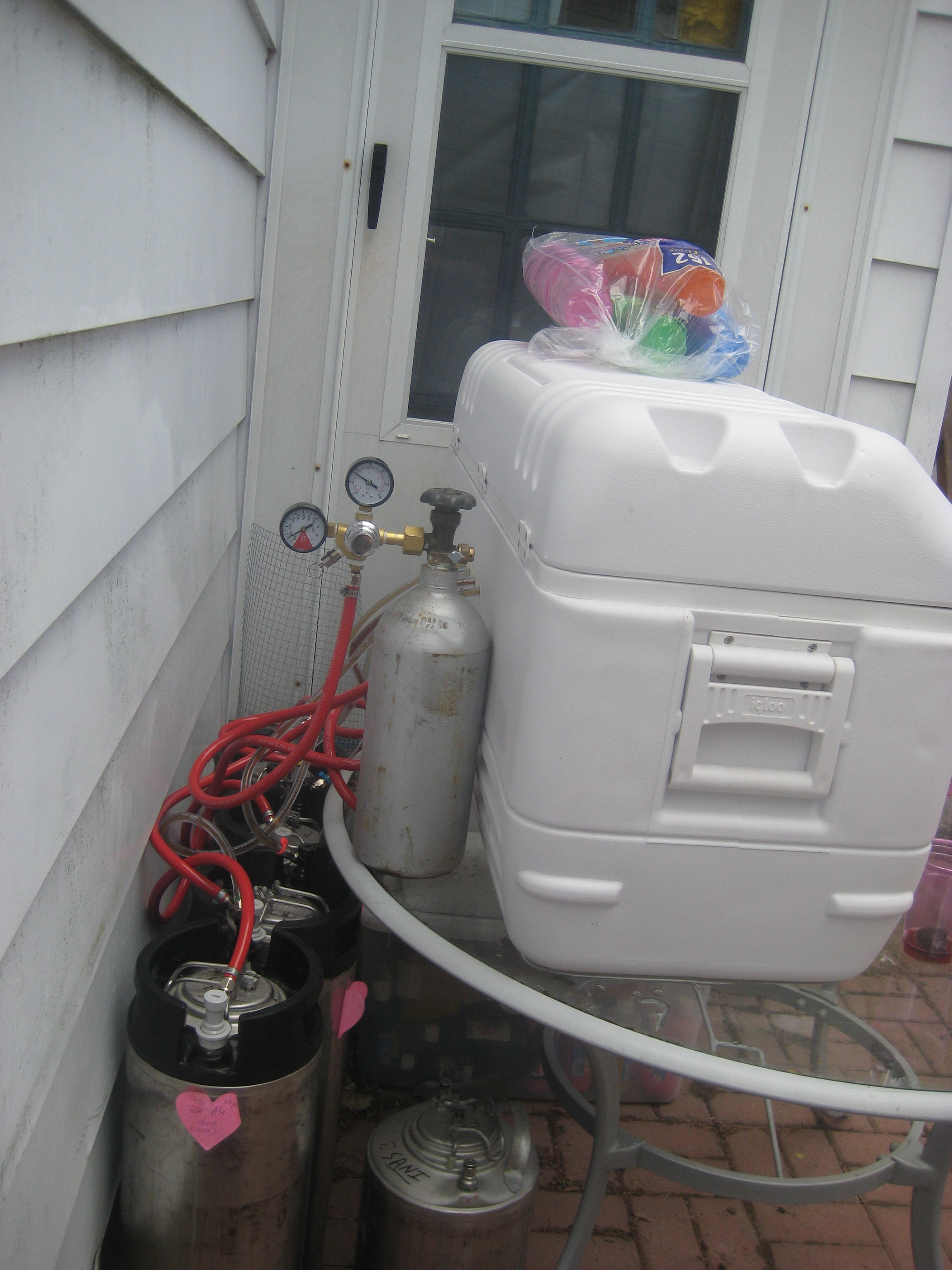
the final step is to attach the gas manifold to the back of the cooler. Simply epoxy the back of the manifold to the cooler and secure with screws. The line into the manifold will attach to the regulator which will attach to the co2 tank. Each line coming out of the manifold will attach to a keg.
All the DIY is done. No just attach all the beer lines and gas lines to the kegs. Turn on the co2 and let the pressure balance out between the kegs and Enjoy!
Cheers!


July 21st, 2009 at 12:50 pm
Looks pretty awesome!
August 31st, 2009 at 11:50 pm
I know this may be an amateur question, but what components would you need to change to connect the jockey box to a 5″ keg?
September 1st, 2009 at 12:43 am
What kind of connection does your keg have? Mine were ball-lock style, typical for 5gal Corney (Pepsi) kegs, which were 1/4″. Basically in step 5 where you are attaching the beer line, the 3/16″ line out of the jockey box connects to your keg. The end of this line should connect to the appropriate fitting for your keg.
September 1st, 2009 at 6:01 pm
Well, I want to connect to two full barrel kegs….so I want to know how to actually connect this to the couplers…..thank you.
September 3rd, 2009 at 3:35 pm
There are several types of sankey couplers to the keg, D is the most common, but there is also A, G, M, S, U (
http://www.micromatic.com/beer-questions/brands-of-beers-use-same-keg-tapping-equipment-aid-47.html), but most likely they will have the same connectors, a 3/8″ barb which will fit the gas line I describe above.
To connect teh beer line out to the tap shank you’ll need a threaded connecter like this one (http://www.micromatic.com/draft-keg-beer/hoses-pid-547C60A.html) don’t forget a neoprene washer for a good seal, well worth $0.50!
Plus the Sankey coupler and your in business. Hope this helps!
September 10th, 2009 at 12:57 pm
thank you, so much!
September 10th, 2009 at 12:58 pm
Great! Thank you, again.
September 10th, 2009 at 1:18 pm
send us pictures when your done and I’ll post them!
January 9th, 2010 at 7:48 pm
[...] around $80 for a 2 pot unit. 2) Anyone seen success with using coiled up beer hose? Like this: http://www.simplybeer.com/blog/jockey-box/ I realize the beer hose won't have the same benefits the stainless will have but it is a fairly [...]
February 5th, 2010 at 10:17 am
I was just wandering what kind of temp the beer comes out with this set up
Thanks
February 5th, 2010 at 10:35 am
Jeff, while I haven’t actually measured the temp, the beer comes out chilled around 40-45deg. Usually my kegs are stored at room temp which can be anywhere from 65-70deg. So over the 25 foot run it is cooling down roughly 25 deg. I also make sure there is enough ice to cover all the flexible PVC.
April 2nd, 2010 at 2:22 pm
Wow spacing out the plastic tubing is a great idea and so much more cost effective then buying the copper tubing.
Great Job. Im def going to make one of these for football tailgate season!
April 2nd, 2010 at 2:29 pm
Thanks Phil, I recently redid the box. I downsized to 54 quart from that monsterous 92 quart cooler. I also got rid of the PVC supports, they didn’t add any benefit. Still have the 4 taps, but it is much easier to move around now!
April 2nd, 2010 at 2:43 pm
Very cool! And thanks for the follow up notes. Do you have any other suppliers to recommend? Looks like the ones listed are out of stock. You mentioned removing the pvc. Did you have to zip tie or do anything at all to protect the surgical tubing in the insulator? Any other modifications or updates?
April 2nd, 2010 at 3:13 pm
Thanks Joe. I used zip ties and made 2 coils out of each 25′ line. That seems to be enough to chill the beer. I don’t like to server my homebrew to cold.
June 22nd, 2010 at 6:23 pm
I’m intrigued that you use rubber tubing instead of copper? do you feel that it cools the beer as well as copper would? it’s a whole lot cheaper!
June 22nd, 2010 at 10:46 pm
@Robb I used the food grade PVC, It works best with a full chest of Ice and to get the shanks in the ice too. If I had the money I may have used copper, but this was an economical and easy to install substitute.
September 10th, 2010 at 3:00 pm
I’m hoping to make one of these for my cousin’s wedding! What a great, and economical setup!
October 7th, 2010 at 10:25 am
Copper should not be used for post fernented beer. I could lead to copper poisoning,
So stainless is the way to go.
HOWEVER! I love the idea of PVC tubing. I’m making a simple picnic tap jockey box for a camp out next weekend. Mine won’t be this pretty but hopefully just as functional!
January 24th, 2011 at 9:12 am
hello, I want to know if cooled too much? I want to do for beer bottles. I live in Argentina. Greetings and thanks
sorry for my Inglés
January 24th, 2011 at 3:03 pm
Alejandro, It cools beer enough for me. If you want a beer colder, you can refrigerate the keg the night before, or substitute the the flexible tube for a cold plate.
January 24th, 2011 at 8:32 pm
hi, thanks for responding. That temperature measurement do you use? Fharenth or Celsius? thanks, I feel very good idea
January 24th, 2011 at 9:28 pm
Hi Alejandro, I use Fahrenheit. Good luck and drop us a line if you have more questions!
February 23rd, 2011 at 1:57 pm
I’m looking to piece one of these together this weekend. How has it worked for you and is there was anything you’d have done differently. How do you clean the lines after you use it? I’m planning to use a 33qt cooler with 2 taps, should be enough room for the coil and ice, right?
February 23rd, 2011 at 2:11 pm
Hi Ronen, I’m actually upgrading mine right now to use a cold plate. The food grade PVC is great on the cheap, but I wanted mine to be more streamlined so I can put bottles and other things in the cooler. I’m also going to add pass through shanks and quick disconnects to make it neater, but also increases the cost.
To clean flush with BLC asap after use. Don’t let beer sit in the lines while not in use.
I’m going to add a new dyi this week with my new changes.
February 23rd, 2011 at 2:45 pm
That’s why I like the vinyl line straight from the shank to the keg. Keeps the initial cost low and I can swap out parts and upgrade slowly. I made sure the cooler I’m using can fit a cold plate so I can sneak it in later when my wife’s not looking…
Did 25′ work out ok?
Do you put the BLC in an empty keg with CO2 to push it through?
February 23rd, 2011 at 4:58 pm
I made mine back in October! 25′ of beer line was plenty! worked great! stayed cold all weekend, reloaded ice once just to top it off.
I’d like to upgrade to stainless… at some point.
February 24th, 2011 at 8:38 am
Chris, I’ll be posting an update to this DIY Project this week (or next) with the stainless upgrades. Cheers! Glad it worked out well for you.
April 12th, 2011 at 12:43 am
Be sure to check out the Jockey Box Upgrade DIY! http://www.simplybeer.com/the-jockey-box-project-updated/
July 24th, 2011 at 11:23 pm
This is a great how-to and I am planning on making the same this month.
I’ve been researching PVC tubing vs. Stainless Steel and want to go with Stainless Steel, but I’m unsure if I can do the 50′ coil and not have to ice my kegs down. I’ve read that the 120′ coil needs no ice on kegs and only in cooler, but to do a 4 tap jockey box I would have to buy a huge cooler and they cost alot.
Any suggestions or input on stainless steel coil and if the beer will stay chilled with no foam or will the kegs need to be on ice.
Thanks!
July 25th, 2011 at 9:35 am
Kipp, Suprisingly, the pvc tubing works suprisingly well. I have since upgraded my box to use aluminum chill plates. these work great in my 4 tap, 42qt cooler. The only draw back is the box is a bit heavy. Check out the updated version (http://www.simplybeer.com/the-jockey-box-project-updated/)
July 26th, 2011 at 8:16 pm
Thanks for the quick response and your updated version looks great!
I think I’m definitely going away from the PVC and now need to decide coil vs chill plates. Do you recommend any certain chill plate?
Also do you have trouble with keeping water off of your plates or having to push them down in the ice? I only ask because I’ve read that can be a common problem.
After all is said and done when it is a hot day do you still chill or ice down your kegs or just keep them out of the sun?
July 27th, 2011 at 11:57 pm
Hi Kipp, I used the 2 channel aluminum chill plates from Midwest Homebrewing. These suckers weight about 15lbs a piece, so there is no issue with them being submerged and staying that way. There is no need to chill your kegs with these chill plates, but you don’t want your kegs to warm to begin with.
March 5th, 2012 at 8:07 pm
This is an awesome project. Looking forward to starting my own. This questions may have been answered already, but wanted to make sure. I have been doing a lot of research on building a Jockey Box and have found differing lengths of coil. A lot of sites say that 50′ would work fine to chill the beer down, while others say 120′. What would be the best recommendation?
Thanks!
March 6th, 2012 at 3:07 pm
JeepScott, thanks for the comment. It is a very cool and simply project to do. The bottom line is the more exposure time you have to the ice the colder it will become. Stainless steel coil and chill plates are the most effective. Using the food grade PVC flex tubing requires more/ longer exposure to ice to get the same rate of cooling. I used 25′ and chilled my kegs to get the temp I wanted.
April 24th, 2012 at 12:07 pm
So how much did the whole setup run you? Looks pretty cost-efficient too. The commercial Jockey Boxes go for $300-400!
April 24th, 2012 at 12:34 pm
it really depends on how much you spend on the parts, cooler, taps, subbing a chill plate, will increase the costs. if you don’t have to buy the cooler, the other parts should be under 150.
June 12th, 2012 at 9:57 pm
From all of what I have seen wouldn’t it be easier to have one larger co2 tank and use a manifold system to distribute. I also noticed that you are not using reinforced nsf tubing , don’t you run the risk of blowing out your tubing under pressure. I also noticed you don’t have many feet in your coils though I liked the jig you made to hold your coils. How does the plastic tubing dissipate heat? I would like to use stainless steel but it is insanely expensive.
June 13th, 2012 at 9:42 am
Thanks for the comments Allen. I use a manifold so i can turn on and off the gas to individual tanks as needed since I’m running with 4 corneys. I’m using standard tubing for draft lines (5/16″ I.D. Clear Vinyl Hose) that will not be affected by cleaning chemicals. The tubing will not burst, even if pushing beer way over normal dispensing pressure. The tubing worked fine as a low cost alternative to metal coils. SS is very expensive.
I rebuilt the box a while back and upgraded to cold plates (http://www.simplybeer.com/the-jockey-box-project-updated/) which I like much better then the vinyl and is a bit less expensive then SS coils.
July 16th, 2012 at 10:58 pm
I assume if I want colder beer all I have to do is add more linear feet of PVC flex tubing … say increase to 75 ft.?
July 17th, 2012 at 8:51 am
if you want colder beer, yes you can add more linear feet, but you may want to consider a cold plate like I used in the upgrade (http://www.simplybeer.com/the-jockey-box-project-updated/) or stainless steel tubing
November 15th, 2012 at 12:19 pm
Jockey boxes are fine and a good way to provide portability to keg beer, but I have one qualification which probably doesn’t apply to readers here. A favorite tavern of mine lost a few of their tap lines due to some malfunction and instead of fixing it, moved some of their kegs to tap through a jockey box. Unfortunately the beers they choose to dispense this way were my favorites, but slow movers. As a result they have kegs sitting at room temp. for many weeks which has the effect of damaging the flavor of the beer.
November 15th, 2012 at 5:18 pm
Jockey boxes are not designed as permanent dispensers. I wouldn’t be frequenting a bar that served out of a jockey box… unfortunately you know why.
December 23rd, 2012 at 10:18 pm
This is the only time I’ve seen the vinyl tubing be used, and from looking at specifications for the tubing and other websites, this 3/16″ tubing is only recommended for 5′-8′ lengths or less, or it causes a lot of foam. You didn’t have any problems with this?
December 23rd, 2012 at 10:54 pm
What pressure did you run the box at when you used the 3/16″ tubing? The restriction pressure of that tubing at 25′ would be 75 lbs, well above the recommended pressure of 12-14 lbs. This should of caused a ton of foam. It appears that 5/16″ tubing would be a lot more appropriate.
December 26th, 2012 at 10:13 pm
I never had issues I would run about 20lbs on a 5gal carboy with out foaming issues. I’m since upgraded to cold plates which i like better